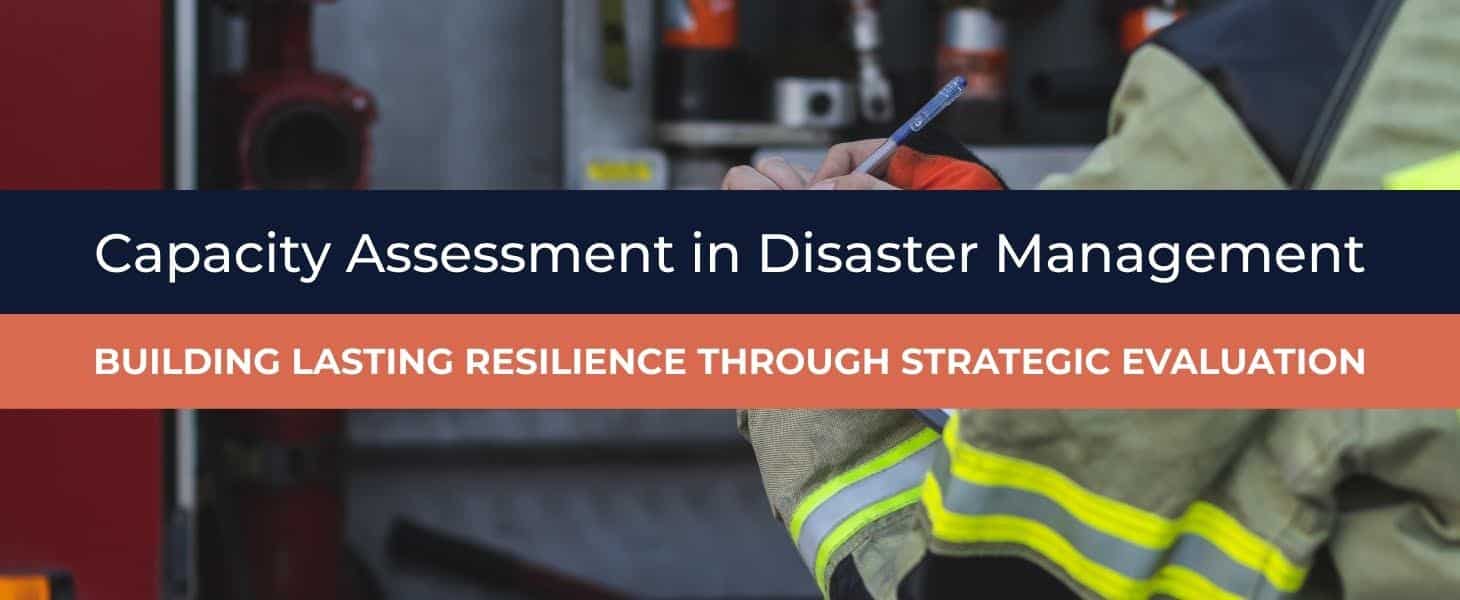
Capacity Assessment in Disaster Management: Building Lasting Resilience Through Strategic Evaluation
Capacity assessment in disaster management evaluates whether your organization can actually respond when crisis strikes, not just what resources you have on paper. It goes beyond counting equipment and personnel to test functionality under stress, examining individual skills, organizational processes, and institutional frameworks together. Effective capacity assessment identifies genuine vulnerabilities before disasters expose them, enabling evidence-based resource allocation and continuous improvement that builds lasting resilience. This strategic evaluation transforms reactive crisis management into proactive disaster risk reduction.
Key Takeaways
- Capacity assessment must evaluate function, not just inventory – Testing whether resources work under actual disaster conditions, not just counting what exists.
- Multi-level assessment is critical – Individual, organizational, and institutional capacities must be examined together, as weakness at any level cascades through the system.
- Social bonds and trust networks often matter more than infrastructure – Communities with strong social cohesion demonstrate significantly better disaster outcomes.
- Skills deteriorate rapidly without practice – Training effectiveness degrades within months without regular refreshers and practical application.
- Local ownership and indigenous knowledge are essential – Community-designed assessments capture critical capacities that external evaluations miss.
- Coordination failures, not resource shortages, cause most response delays – Assessment must trace information flows and decision pathways between organizations.
- Mixed methods reveal complete capacity pictures – Combining quantitative metrics with qualitative insights uncovers hidden strengths and vulnerabilities.
- Assessment must be continuous, not episodic – Regular evaluation prevents capacity erosion and enables proactive adjustments.
Understanding Capacity Assessment Fundamentals
Defining Capacity in Disaster Risk Reduction Contexts
Start with what capacity means in disasters: the complete ecosystem enabling communities to anticipate, prepare, respond, and recover. Not just the fire trucks you can count, but the neighbor who knows which elderly residents need help evacuating. Not just the emergency operations center, but whether staff trust leadership enough to report problems.
The latent-active distinction drives opportunity. That retired nurse in the community represents latent capacity—skilled but unengaged. Your DRR assessment framework must find her. Active capacities need different attention: optimization and sustainability. The volunteer search team that responds to every call risks burnout without support systems.
Physical resources tell half the story. Research on the 2004 Indian Ocean tsunami revealed that pre-tsunami household composition was predictive of survival, with evidence suggesting stronger family members sought to help weaker members during the disaster¹. Trust networks determined who listened to evacuation warnings. Indigenous knowledge identified natural warning signs. Informal leadership structures coordinated response faster than official channels.
Capacity operates in layers: individual knowledge compounds into organizational capability, which builds institutional resilience. Weakness at any level cascades. When individual responders lack training, organizations can’t execute plans. When organizations fail, institutions collapse. Your assessment must examine each layer and—critically—the connections between them.
The Strategic Role of Capacity Assessment
Assessment transforms disaster management from reactive scrambling to proactive disaster risk reduction capacity building. Without it, you’re guessing where problems hide, hoping interventions work, and wondering why communities remain vulnerable despite investment.
Gap identification goes deeper than counting missing equipment. True assessment reveals why gaps exist. That shortage of first responders might stem from inadequate training facilities. Dig deeper: cultural barriers prevent women from joining. Economic pressure keeps potential volunteers in second jobs. Transportation costs exclude rural participants. Each layer of “why” points toward different solutions.
Evidence-based resource allocation follows naturally from good assessment. The Sendai Framework advocates for this approach because politics and visibility too often drive resource distribution. Wealthy neighborhoods get new equipment while vulnerable communities—less visible, less vocal—deteriorate. Assessment data cuts through politics with facts: here’s where people die, here’s what fails, here’s what needs investment.
Context specificity emerges from recognizing that flood capacity in Bangladesh differs fundamentally from flood capacity in Berlin. Seasonal flooding in riverine communities integrates into agricultural cycles, requiring different capacities than flash floods in urban canyons. Copy-paste solutions fail because context determines what works.
Without baseline measurements, improvement claims remain stories. Quantified starting points enable accountability. They show donors return on investment. They prove to communities that efforts produce results. They reveal when strategies aren’t working, enabling course correction before disasters prove failures fatal.
Evolution of Capacity Assessment Frameworks
The field’s evolution traces hard lessons written in disaster statistics. Early frameworks counted ambulances and hospital beds—response assets. They missed the prevention capacities that determine whether those resources become overwhelmed. Modern disaster management capacity assessment frameworks assess the entire disaster cycle.
Vulnerability and capacity are one equation. Excellent evacuation plans mean nothing if significant portions of residents lack transportation. Strong early warning systems fail if messages arrive in languages communities don’t speak. Modern disaster resilience frameworks explicitly link these dimensions because addressing one without the other creates dangerous assumptions.
Local ownership revolutionized assessment accuracy. External evaluators miss critical local capacities while overvaluing familiar but inappropriate solutions. The Philippines’ barangay disaster risk reduction management committees demonstrate success when communities design their own assessment criteria based on experienced hazards. They know which bridges fail first, which neighborhoods flood fastest, which leaders people trust.
Systems thinking recognizes that disaster capacity operates within complex adaptive networks. That new emergency operations center might reduce response capacity if it centralizes decisions away from distributed local knowledge. The backup generator improves resilience unless its fuel supply depends on the same roads that flooding destroys. Assessment must capture these interdependencies.
Indigenous knowledge integration corrects historical blindness. Pacific Island communities use traditional environmental indicators—bird migration patterns, wave formations, cloud colors—to predict weather patterns that complement modern forecasting for local conditions. Assessment frameworks that ignore these capacities miss resilience resources evolved over generations.
Core Dimensions of Organizational Capacity
Human Resource Capacity
Staff count represents a starting point, not the full picture. Technical competencies, multi-hazard knowledge, and leadership capabilities transform individuals into effective responders. Assessment must evaluate depth of expertise across the organization. Does one person hold critical knowledge that creates vulnerability? Can remaining staff maintain operations if key personnel become casualties?
Training completion percentages mask crucial realities. Skills degrade without practice. A responder certified three years ago may have forgotten critical procedures under actual emergency stress. Assessment must verify current competency through practical evaluations, not paper credentials. Simulation exercises reveal whose skills remain sharp and whose need refreshing.
Psychological resilience matters as much as technical skill. Repeated exposure to traumatic incidents without adequate support leads to burnout, PTSD, and high turnover. Assessment must evaluate mental health support systems, work-life balance policies, and psychological first aid capacity for both responders and affected populations.
Succession planning prevents institutional knowledge loss. When experienced staff retire or transfer, decades of disaster-specific learning vanishes unless systematically captured. Mentorship programs, knowledge management systems, and overlap periods during transitions preserve this capacity.
Diversity strengthens response capability. Teams representing served communities’ linguistic, cultural, and demographic makeup build trust faster, communicate more effectively, and identify needs others miss. Assessment should evaluate whether your organization’s composition enables this advantage.
Organizational Structure and Processes
Clear roles and responsibilities prevent coordination failures under stress. When everyone assumes someone else handles critical functions, gaps emerge. Assessment must verify that documented responsibilities align with actual understanding across the organization. Does the person assigned to activate mutual aid agreements know they have this role?
Standard operating procedures exist in most organizations. Effective SOPs are another matter. Assessment must test whether procedures work under realistic disaster conditions: degraded communications, absent leadership, resource constraints, and time pressure. Desktop exercises reveal whether your processes match operational reality.
Decision-making authority distribution determines response speed. Overly centralized structures create bottlenecks during crises when communication networks fail. Effective incident management and reporting requires distributed authority with clear escalation protocols, frontline responders empowered to act within defined parameters while knowing when situations exceed their scope.
Quality assurance mechanisms separate organizations that learn from those that repeat failures. After-action reviews, incident databases, and systematic improvement processes transform experiences into enhanced capacity. Assessment should evaluate whether your organization treats failures as learning opportunities or blame events that encourage cover-ups.
Adaptive capacity matters when disasters exceed plans. Improvisation becomes necessary, but effective improvisation builds on solid foundations of training, trust, and shared mental models. Assessment must evaluate organizational culture: do staff feel empowered to adapt, or does rigid adherence to procedures prevent appropriate responses to novel situations?
Infrastructure and Equipment
Physical infrastructure assessment begins with location analysis. That generator mentioned earlier failed because placement ignored flood risk. Critical facilities need evaluation against all hazard scenarios: seismic safety for earthquake zones, elevation for flood-prone areas, wind resistance for hurricane regions. Infrastructure that survives disasters enables response; infrastructure that fails compounds crises.
Equipment functionality goes beyond existence. Maintenance schedules, testing protocols, and replacement plans determine whether resources work when needed. The expired medications in your stockpile, the uncharged batteries in emergency radios, and the vehicles that won’t start represent false capacity—dangerous because they’re counted but unavailable.
Technology systems require assessment beyond hardware specifications. Can your database function offline when internet connectivity fails? Does your emergency notification system reach all population segments, including those without smartphones? Remote incident management capabilities have become essential—assessment must verify that technology enables, rather than constrains, distributed response coordination.
Redundancy and backup systems protect against single points of failure. Assessment must identify dependencies: shared infrastructure, single-source vendors, concentrated expertise. Community-wide infrastructure assessment reveals cascade risks across interdependent systems.
Logistics resilience spans the complete supply pipeline: supplier reliability under disaster conditions, warehouse vulnerability to hazards, transportation network redundancy, and last-mile distribution capability. COVID-19 exposed critical weaknesses traditional assessments missed: single-source dependencies and just-in-time inventory systems collapse under surge demands.
Information management extends beyond data collection to utilization. Many agencies drown in data while starving for actionable information. Assessment must identify bottlenecks in the information-to-decision pipeline. Where does data accumulate without analysis? Where does analysis fail to reach decision-makers? Where do decisions fail to trigger action?
Coordination mechanisms work on paper but fail under stress. Inter-agency agreements exist, but can agencies execute coordinated responses when communications degrade, leadership is unavailable, and situations exceed plans? Assessment must test these mechanisms under realistic conditions, not ideal scenarios.
Financial preparedness encompasses the complete fiscal framework. Budget flexibility to redirect funds rapidly. Insurance and risk transfer coverage. Contingent credit arrangements. Emergency expenditure tracking. Countries with established financial preparedness mechanisms demonstrate faster resource mobilization—the difference between timely response and cascading crisis.
Transforming Assessment into Sustainable Capacity
Bridging Assessment Gaps with Strategic Interventions
Not all gaps are equal. Some represent critical failure points; others cause manageable inefficiencies. Risk-based prioritization addresses high-probability, high-impact gaps first while building comprehensive capacity. That missing backup communications system matters more than outdated office furniture, even if the furniture appears on more complaints.
Balance hardware with human systems. The new emergency operations center (structural) fails without trained operators, maintained procedures, and practiced protocols (non-structural). Evidence suggests investing in both structural and non-structural measures optimizes outcomes, though context adjusts these ratios.
Dig for root causes. High staff turnover might appear salary-driven. Deeper assessment reveals burnout from repeated deployments without psychological support. Career progression limitations. Family impacts from unpredictable schedules. Addressing symptoms through salary increases alone fails; systemic reform sustains improvement.
Build on existing foundations. Communities with strong traditional governance adapt these for disaster risk reduction capacity building better than imposed parallel systems. Agricultural cooperatives expand into preparedness networks. School systems integrate risk education. Assessment identifies these leverage points where small investments multiply impact.
Create feedback loops between assessment and implementation. Initial assessments prioritize earthquake preparedness, but climate change shifts hazard profiles toward flooding. Dynamic assessment detects these shifts, triggering strategy adjustments. Regular updates for high-risk areas maintain intervention relevance as contexts evolve.
Building Enduring Institutional Capacity
Make assessment routine, not exceptional. Many organizations assess only when donors require or disasters strike, missing gradual erosion between events. Integrate assessment schedules with budget cycles and strategic planning. What gets measured gets maintained.
Develop internal assessment capacity to escape consultant dependency. Train staff in assessment techniques. Establish assessment units within agencies. Create assessment career paths that professionalize this function. Organizations conducting their own assessments demonstrate better capacity retention than those relying solely on external evaluation.
Protect assessment integrity through governance frameworks. Assessment reveals politically uncomfortable truths about underserved populations and ineffective programs. Independent oversight bodies, transparent publication requirements, and legislative mandates for assessment-based planning prevent political interference while ensuring findings inform policy.
Institutional memory requires active preservation. Staff turnover eliminates decades of experience. Digital repositories of assessment reports, lessons learned databases, and standardized handover procedures preserve knowledge, but only with active maintenance and regular use. Abandoned databases provide false security.
Track capacity changes over time to transform snapshots into video. Capacity degrades without maintenance, evolves with practice, shifts with context. Longitudinal tracking identifies concerning trends before they become critical failures, enabling preventive intervention rather than crisis response.
Community-Centered Assessment Approaches
Local knowledge systems evolved over generations contain sophisticated risk management. Traditional weather prediction, indigenous construction techniques, and customary mutual aid represent refined disaster capacities. Assessment frameworks that document and validate these systems reveal strategies that complement modern approaches.
Shift from extractive evaluation to collaborative learning. Communities become research partners, identifying capacity indicators, conducting peer assessments, and interpreting results through local frameworks. This reveals dimensions external assessment misses: social cohesion metrics, trust indicators, cultural resilience factors.
Disaggregate for equity. Gender-specific assessment reveals women’s distinct capacities—social network maintenance, healthcare knowledge, resource management—undervalued in conventional frameworks. Disability-inclusive assessment identifies both vulnerabilities and unique capacities. Age-stratified assessment captures elder wisdom and youth innovation.
Build assessment literacy locally. Simplified tools in local languages allow communities to track progress between formal evaluations. This democratization challenges expert-driven approaches but produces more accurate, actionable, and owned results.
Foster two-way knowledge exchange. Technical experts gain context understanding that improves assessment design. Communities acquire assessment skills strengthening self-advocacy. This partnership moves beyond hierarchical knowledge systems toward collaborative resilience building.
Moving From Assessment to Action
The generator that opened this guide—flooded, useless, counted as capacity—represents assessment’s core challenge. We measure what exists, not what works. We count resources, not resilience. We assess response, not prevention.
True disaster management capacity assessment changes this. It reveals why the generator was installed at ground level (no one asked the facilities manager about flood risk). It identifies who knew about the vulnerability but lacked channels to report it. It examines why procurement processes prioritized price over placement.
Your next assessment must go deeper than inventory. Test systems under stress. Include communities as partners, not subjects. Examine connections between levels. Build on existing strengths. Address root causes. Create continuous improvement cycles.
Remember that capacity assessment isn’t about generating reports—it’s about building resilience that saves lives. Every gap identified but not addressed represents future casualties. Every capacity built without community ownership will erode. Every assessment that sits on shelves rather than driving action wastes precious preparation time before the next disaster.
The communities you serve don’t need perfect assessments. They need honest evaluations that reveal real vulnerabilities and genuine capacities. They need assessment processes they own and trust. They need findings that drive action, not paperwork.
Start where you are. Assess what you have. Build what works. The next disaster won’t wait for perfect conditions, and neither should your assessment.
Strengthen Your Organization’s Disaster Response Capacity
Effective capacity assessment reveals vulnerabilities before they become crisis points, but assessment alone isn’t enough. Your organization needs proven systems that transform insights into actionable response capabilities.
FIRM provides enterprise incident management solutions designed to turn assessment findings into operational readiness. Whether you’re addressing gaps in coordination protocols, strengthening distributed response capabilities, or building institutional resilience across complex organizations, our platform enables the systematic capacity building that assessments recommend.
Ready to move from assessment to action? Contact our team to discuss how FIRM can help your organization build the incident management infrastructure that capacity assessments identify as critical. Don’t wait for the next disaster to expose vulnerabilities you could address today.

Related posts
Disaster Recovery Plan Template: A Complete Guide for Property Managers
A disaster recovery plan template must include seven core components to be compl

Multifamily Market Trends Changing the Industry
Property management companies didn’t need to look far for extra challenges in

Contractor Invoice Example: Templates That Get You Paid Fast
The check should have arrived two weeks ago. You finished the job, cleaned up th