

How FIRM Vets Restoration Contractors for Your Properties
A pipe lets go on the fourth floor at two in the morning. The on-call manager has a phone, a flashlight, and a list of restoration companies nobody has worked with in three years. Somewhere on that list is a contractor who will show up fast, do good work, and bill fairly. Somewhere else on the list is one who will not. There is no way to tell which is which at two in the morning.
That is the problem restoration contractor vetting is meant to solve. It moves the hard questions out of the emergency and into a calm, structured process, so that when the call comes, the answer is already decided. This article walks through how FIRM, the incident management division of FACS, vets and manages the restoration contractors that serve your properties.
Quick Answer
FIRM’s restoration contractor vetting process is a six-step program that identifies qualified restoration contractors, verifies their credentials and capacity, matches them to your properties and service areas, sets service and pricing expectations, coordinates your approval and onboarding, and then tracks performance over time. The result is a pre-approved contractor network built around your portfolio, ready before an incident happens. Learn more about FIRM incident management.
Why Vet Restoration Contractors Before an Emergency
Property damage does not wait for a convenient moment. Water losses, fires, storm damage, and mold discoveries tend to arrive at night, on weekends, and during the busiest week of the quarter. At that moment, the quality of the response depends almost entirely on decisions made months earlier.
When a contractor has not been vetted, the owner or property manager is left to make judgment calls under pressure. Is this company licensed for the work? Do they carry the right insurance? Can they handle a twelve-unit water loss, or only a single kitchen? Will their invoice hold up to review? Each unanswered question becomes a risk to the property, the residents, and the budget.
A structured vetting process answers those questions in advance. It also gives you something that is hard to build in a hurry: a working relationship. Contractors who have been through the program know your properties, your expectations, and your approval process before they ever roll a truck.
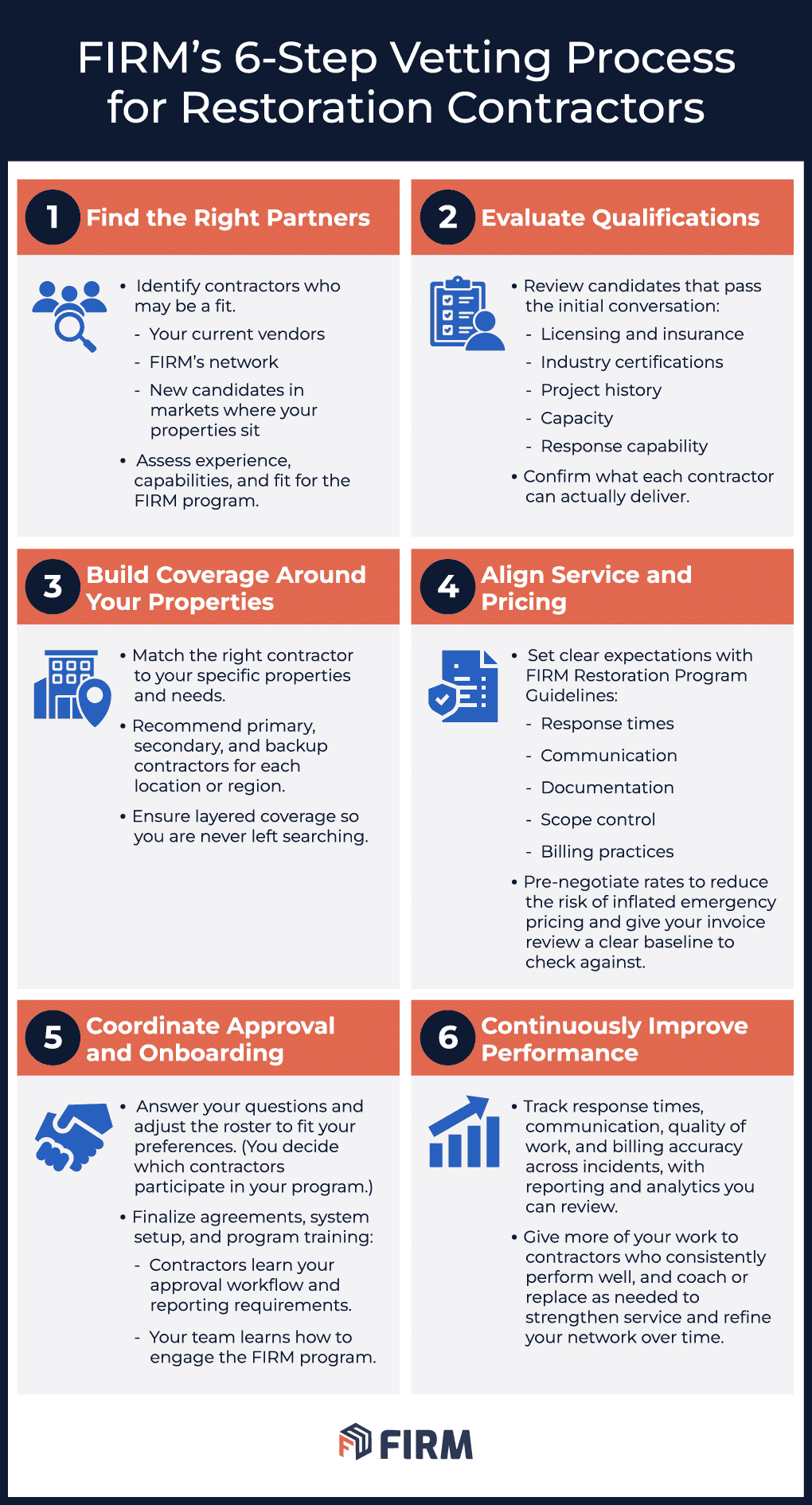
The Six Steps in FIRM’s Vetting Process
FIRM’s current process has six parts. Each one is handled by the FIRM team on your behalf, with your review and approval built in at the points that matter.
1. Find the Right Partners
FIRM begins by identifying restoration contractors and specialists who may be a fit for the program. The pool includes contractors you already use, contractors in FIRM’s existing network, and new candidates in the markets where your properties sit. FIRM interviews each one to assess experience, capabilities, and fit for the FIRM program.
Fit matters as much as skill. A contractor with excellent technical work but no appetite for after-hours calls, or no experience with occupied multifamily buildings, may not serve your portfolio well. The early conversations are where FIRM sorts that out.
2. Evaluate Qualifications
Candidates that pass the initial conversation complete a vetting submission. FIRM reviews credentials, project history, equipment, technology, fleet, and subcontractor resources, then follows up with interviews to fill gaps and confirm claims. Typical items under review include:
- Licensing and insurance. State contractor licensing, specialty licenses where required, and insurance coverage appropriate to the work and your properties.
- Industry certifications. Credentials such as those issued by the Institute of Inspection, Cleaning and Restoration Certification (IICRC), which sets widely used standards for water, fire, and mold restoration work.
- Project history. Recent work of similar size and type, including references and examples of how the contractor handled complex or sensitive losses.
- Capacity. Equipment inventory, drying and monitoring technology, fleet size, staffing, and the subcontractor relationships a contractor relies on for specialty trades.
- Response capability. Realistic after-hours availability and how quickly crews can mobilize to each of your locations.
The goal is a clear, documented picture of what each contractor can actually deliver, not just what their website says.
3. Build Coverage Around Your Properties
Vetting is not finished when a contractor is approved in the abstract. FIRM matches contractor experience, service areas, specialty licenses, and response capabilities to your specific properties and needs. For each location or region, FIRM recommends primary, secondary, and backup coverage.
Layered coverage is what keeps a response moving when the first call does not connect. If your primary contractor is already committed to a regional storm event, the secondary is assigned and ready. The backup is there for the rare occasion when both are tied up. You are never left searching.
4. Align Service and Pricing
FIRM’s Restoration Program Guidelines, tailored to your business, set expectations for how contractors in your program operate: response times, communication, documentation, scope control, and billing practices. Every participating contractor works to the same standard, which makes performance easier to compare and problems easier to spot.
FIRM also works with you to negotiate pricing and discounts with the contractors in your program. Pre-negotiated rates reduce the risk of inflated emergency pricing and give your invoice review a clear baseline to check against.
5. Coordinate Approval and Onboarding
You decide which contractors participate in your program. FIRM presents its recommendations, answers questions, and adjusts the roster to fit your preferences. Once you approve, FIRM helps coordinate the agreements, system setup, and operational training needed to make the program work day to day.
Onboarding is where the process becomes practical. Contractors learn your approval workflow and reporting requirements. Your team learns how to engage the program when an incident occurs. By the time a loss happens, everyone involved already knows the next step.
6. Continuously Improve Performance
Approval is the beginning of the relationship, not the end. FIRM uses vendor performance ratings, ongoing evaluations, and coaching to strengthen service and refine your contractor network over time. Response times, communication, quality of work, and billing accuracy are tracked across incidents and fed back into reporting and analytics you can review.
A contractor who slips is coached. A contractor who continues to slip is replaced. A contractor who consistently performs earns more of your work. The network gets better because it is measured.
What a Vetted Contractor Network Means for You
The payoff shows up in the moments that are hardest to manage. Your on-site staff makes one call. A qualified, pre-approved contractor who knows the property responds. Scope and pricing follow guidelines that were agreed to in advance. The invoice can be checked against known rates. And every incident adds to a record that makes the next decision better informed. FIRM’s case studies show how this plays out across real portfolios.
This structure serves multifamily property managers, commercial property managers, hospitality operators, college and university housing, and military housing alike. The properties differ. The need for a reliable, accountable restoration partner does not.
Frequently Asked Questions
What is restoration contractor vetting?
Restoration contractor vetting is the process of evaluating water, fire, mold, and storm damage contractors before an emergency occurs. It verifies licensing, insurance, certifications, capacity, and track record, and it establishes pricing and service expectations in advance so that response decisions are not made under pressure.
Do I need to sign a contract with each restoration contractor?
Not as part of the vetting process. FIRM maintains a vendor service agreement with every contractor partner in its network. Whether your organization also chooses to hold a master service agreement (MSA) with a particular contractor, or to authorize work at a specific property through a work authorization when an incident occurs, is a separate decision made on your terms. FIRM can help coordinate whichever approach fits your business.
Can my existing contractors be part of the FIRM program?
Yes. Contractors you already work with are included in the pool FIRM evaluates. If they meet the program’s qualifications and agree to its guidelines, they can be approved and assigned coverage alongside contractors from FIRM’s network.
How often are contractors re-evaluated?
Evaluation is ongoing rather than periodic. FIRM rates contractor performance on each incident and reviews those ratings over time. Coaching, reassignment, or replacement follows from the record, not from a calendar date.
Who approves the contractors assigned to my properties?
You do. FIRM identifies, evaluates, and recommends contractors, but final approval of the roster for your program rests with your organization.
If your properties are covered by a contractor list that has not been reviewed in a while, that is a reasonable place to start. FIRM can walk through your current coverage, identify gaps, and explain how a vetted contractor program would work for your portfolio. Contact FIRM or call (866) 960-6376 to begin the conversation.

Related posts

How Do Insurance Companies Pay Out Claims?
Insurers settle commercial property claims through a defined sequence you can pr

Contractor Invoice Example: Templates That Get You Paid Fast
The check should have arrived two weeks ago. You finished the job, cleaned up th
What Is WIP In Accounting? Work-in-Progress Guide for Property Managers
Work-in-progress (WIP) in accounting represents the accumulated costs of partial
Leave a Reply